- Role
- Creative Director, Design Direction, Product Design
- Year
- 2021
- Client
- Enterprise, Home Sales, Homebuilding
- Industry
- New Homes, Real Estate
- Team
- Skills
Dreamweaver
A white-label module that lets a new-home buyer pick a lot, customize a floor plan and visualize rooms on a builder's own site
Overview
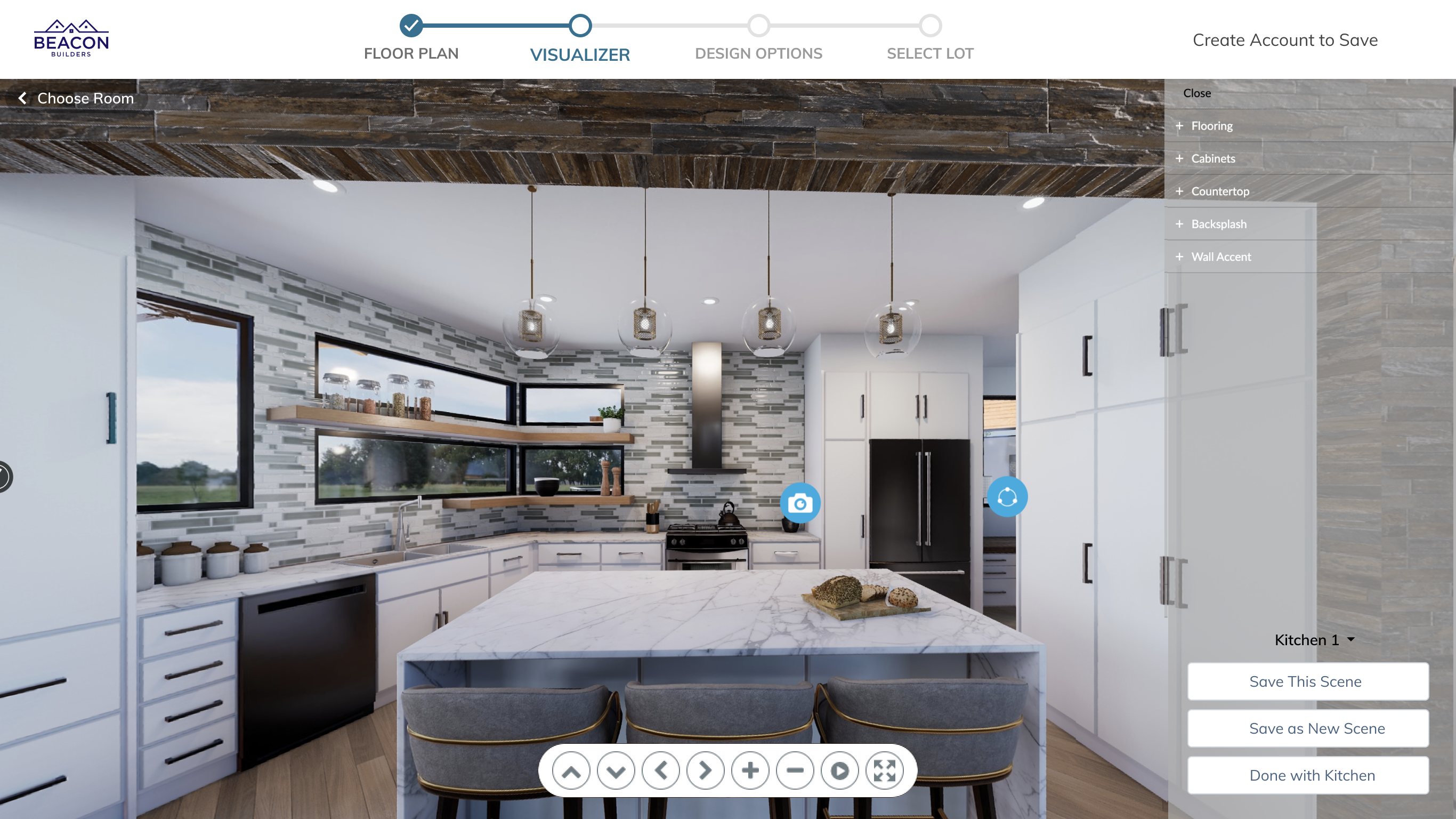
Dreamweaver is a module a homebuilder deploys on its own website: a buyer picks a homesite on an interactive site plan, customizes an interactive floor plan, steps into a room visualizer, and saves the result as a lead for the builder.14 My team designed the MVP in two orders (floor plan first and site plan first), a white-label demo and design system, and then, in spring 2021, a version with the Envision visualizer built into the flow, which we tested with six homebuyers.567 Four of the six said they would use it in their home-buying journey and two said maybe.8 [NEEDS Q: Rocksauce or EX Squared? Every dated deck here, March to August 2021, carries the Rocksauce name,9 and no file mentions EX Squared, but the work sits inside the BHI family that also owned EX Squared, and two decks postdate the 06/2021 rebrand record. Confirm this was Rocksauce work.]
Problem
Competing tools each did one piece well. When my team compared Dreamweaver with Anewgo, the analysis found a good community map and an exterior visualizer, but dead ends where most communities had no lots, and nothing for interiors.10 Against CentraVu, the stand-out was a walk-through module built from 3D rendering and photos of furnished models, which the analysis called the best tool we had reviewed for getting a feel for a future home.11 Dreamweaver's bet was to join the pieces: lot, plan, structural options and interior finishes in one guided flow that lives on the builder's site rather than a third-party portal.4 The business goal behind it is not stated in any file. [NEEDS Q: what was the target: leads, option revenue, builder adoption?]
Users & research
Who. Six people who had just bought a home, were buying, or planned to buy soon, with a mix of interest in new and used homes. Each did a 45 minute one-on-one session with a Figma prototype, then a questionnaire.12 Testing ran between 5 March and 9 April 2021.7
What held up. All six correctly predicted what "Customize Your Dream Home Here" would let them do.13 All six wanted to explore the visualizer, with no hesitation about trying colors, materials and views, and three went straight to packages without being asked.14 Six of six would create an account. They rated the product 4.5 out of 5.8
What did not. Four of six could not tell what the colors on the lot map meant, and four wanted to choose a floor plan before a lot.13 Four did not know what swing, elevation or spec meant on the lot card.15 Only three noticed the cost of an added patio before it slid into the calculator icon.15 Five of six could not find the mood board, and only one of six used the compare slider without prompting; testers expected a true side-by-side.1416 Three were confused that they were asked to pick countertops and cabinets again in design options after doing so in the visualizer, and several felt the account prompt arrived at the wrong moment.17
Approach & trade-offs
Lot first or plan first. We never settled this by opinion. The MVP file carries both orders for desktop and mobile,5 the 2021 updates file carries prototypes that start from the site plan and from the floor plan,6 and the test told us four of six buyers lean plan first.13 The Anewgo comparison added the counter-argument: Anewgo puts lot choice last because some plans only fit some lots, and a plan-first Dreamweaver risks a buyer customizing a plan that fits no available lot.10 The UAT notes list that same unresolved case.3 So the design keeps both entry points and filters plans by homesite.
White label over bespoke. The design system holds builder logo components and the demo file repeats the same flow in three builder skins, plus a brand conversion from one builder identity to another.18 [NEEDS Q: which of Trendmaker, Windsor, Southgate and Tri Pointe were real deployments and which were demos? I have treated all builder names as sample content.]
Words. UAT notes show the label for a saved design moving from "scenarios" and "tours" to "personalizations" and then "visualizations".3 Testing later confirmed that builder jargon was the main comprehension problem.19
Solution
The floor plan step groups options into categories and redraws the plan as each is ticked; our own comp analysis rated that categorised approach above a competitor's single long list, and flagged furniture placement as easy to miss.10
The integrated version replaces the original visualizer panel with Envision's, under a four-step bar: floor plan, visualizer, design options, select lot.6 Desktop and mobile pages for that integration are marked locked for development.20
After the buyer saves, the builder follow-up was designed too: customer emails in a generic and a builder color, and two rounds of UAT notes against the deployed email.21
Results
No usage or lead numbers exist in the files. [NEEDS Q: any results after deployment?] What the round produced was a ranked fix list: more photos and video, clearer calls to action for detail views, labels on unfamiliar icons, plain definitions for swing, elevation, spec, scenario and scene, a clearer way to show cost, a first-use hint on the compare slider, and a test of true side-by-side compare.19 A floor plan page rethink and updated navigation pages follow in the same file.6
What I'd do differently
I would have tested the lot-or-plan question before building both orders, with a simple first-click test, and I would have put the glossary problem in front of real lot cards earlier: four of six people stopped at three words on the first screen that mattered.15 Six moderated sessions was enough to find problems and not enough to rank them; the deck itself recommends unguided testing at a higher count once the product is built.19