- Role
- Account Executive, Creative Director, Design Direction
- Year
- 2021 to 2022
- Client
- Enterprise
- Industry
- Energy, Enterprise, Field Services
- Team
- Skills
SLB Production Engineer Platform
A mobile-first service platform for oilfield production engineers: alerts, work orders, equipment history and support, designed and tested with the people who run the wells
Overview
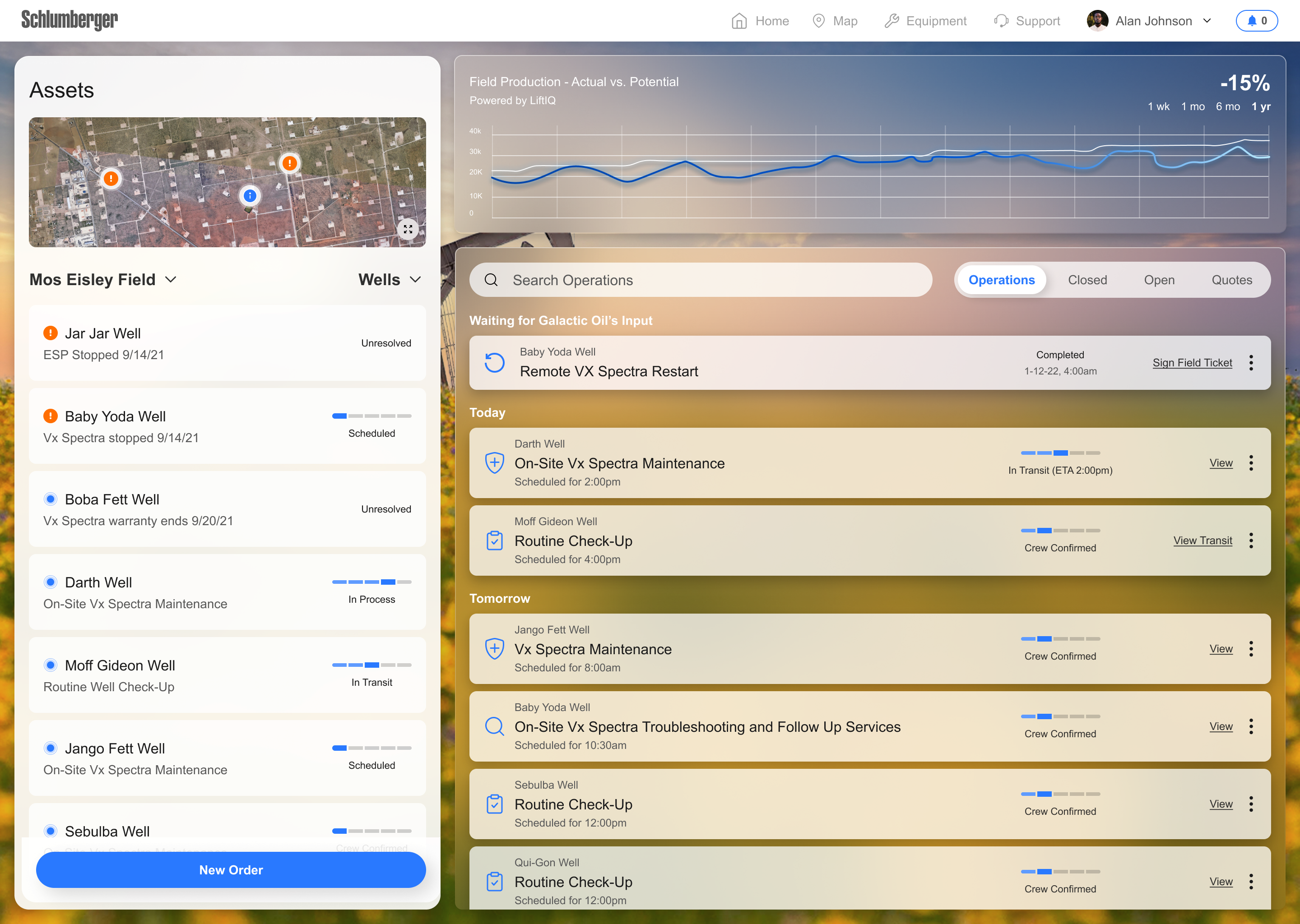
SLB, the oilfield services company, engaged my team to design the customer-facing side of its artificial-lift service business: the app a production engineer would use to see how their electric submersible pumps are doing, order a service, approve work, track the crew coming to site, and get results back. Over a series of design sprints we prototyped each part of that journey, tested it with five production engineers, and delivered a design system and dev-ready UI for four personas across desktop and mobile. A second track in May 2022, DELFI, designed executive reports for SLB's software platform and tested them with five managers from SLB and Chevron.
Problem
When a pump fails downhole, the process to get it fixed ran on phone calls and paperwork: a technician diagnoses, a proposal goes back and forth, approvals pass between as many as six people, and the equipment pulled from the well gets tested somewhere the customer cannot see. The sprint questions we set were whether we could show one home screen with sensible sorting of work orders, deliveries, tests and approvals across a whole fleet rather than one pump, whether we could let people sign off on many decisions across a multi-user workflow without being too chatty, and whether we could help a customer prioritize service calls across all their equipment.
Solution
Sprint 1: notifications and support. All five testers wanted smart mobile notifications with context at a glance and the ability to drill into the technical data. Four of five did not want a live chat that felt like a random dispatcher; they wanted their own account rep, and they expected the app to already know who that was. Video calls with field personnel tested weakly: two of five saw value, three of five doubted the site internet could carry it, so we kept the support center to contact, chat and audio and did not build video into the core flow.
Work orders and approvals. Five of five wanted to review and approve work orders from a mobile interface. The finding that shaped the design was that the flow we drew with two or three users would in real life pass between six or more, so approval had to hand off cleanly between people and be easy to return to across several days.
Tracking crew and equipment. Five of five wanted to track crew and equipment coming to site, in an interface they compared to Uber Eats. Every tester was excited by that screen, and the follow-up questions were all about real-world edge cases: multi-stage deliveries, a crew en route at the same time as equipment, and when a driver's tracking should start.
Test results in hand. Five of five wanted results from equipment pulled from the well delivered to their phone, with the ability to decide right there what to scrap. Much of that data existed only on paper.
Constraints we designed for. Three of five raised alert routing: each customer installation would need a highly customizable admin section. Testers also warned that site internet is unreliable, so anything requiring a connection needed an offline contingency.
What we delivered. A design system with color, glass, text and shadow styles, icons and core components, marked delivered; dev-prep files for authentication, dashboard, well screens, order a service, diagnostic report and proposal, equipment service history, operational time zones and the support center; mobile flows for the production engineer; and UX for three further personas: geologist and subsurface, drilling engineer, and company man. Onboarding was three screens with a skip; four of five testers tapped Get Started immediately, and four of five would enable location access.
DELFI reports. For SLB's DELFI platform we designed customer-care, usage and executive-summary reports and tested them with five managers on the SLB and customer side. Five of five found the executive summary useful for management decisions; four of five were satisfied with the customer-care report with minor adjustments; the usage report drew pushback on metric accuracy, and the portal-uptime figure was called misleading because the portal can be up while a user cannot get in. Testers wanted actionable, in-context recommendations rather than numbers alone.
Outcome
The production engineer UI went to development in December 2021, and the design system was delivered.. SLB is named on my resume as enterprise work alongside Bechtel.
Gallery
Orders and actions.
Well screen with equipment and services.
Mobile home, Mos Eisley Field.
Mobile notifications with context.
Field map with well markers.
Design system: operations icons and card states.
Sprint flow 1: with monitoring.
Workshop day 1 board: 2-year goal and sprint questions.
Prototype: onboarding and account.
DELFI test overview by the numbers.
Service level agreements report findings.
Usage report findings.