- Role
- Brand & Identity, Creative Director, Design Direction
- Year
- 2013 to 2014
- Client
- Entreprenur, Startup
- Industry
- Consumer, Entertainment
- Team
- Skills
Randid
An anonymous, random photo-sharing iPhone app: send one candid, get one back from a stranger somewhere in the world
Overview
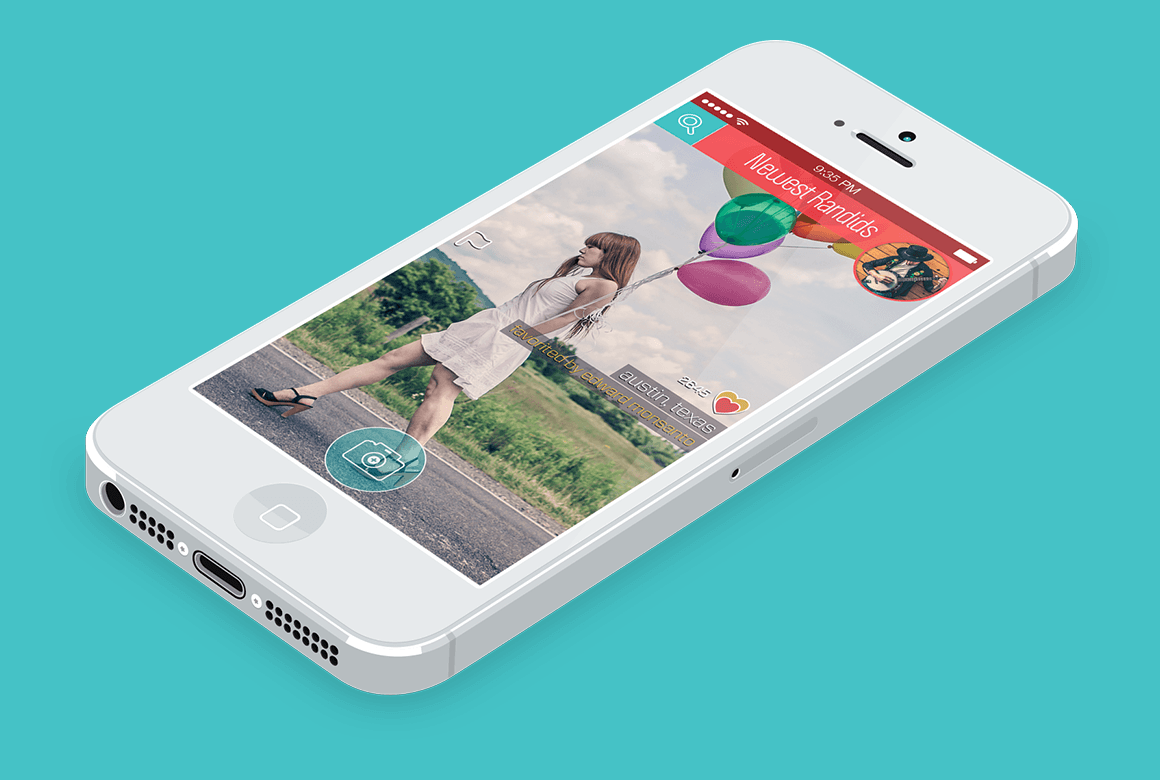
Randid was a photo app built on one mechanic: tap the camera, send a candid photo to a stranger, and get one back from somewhere else in the world. The creator, Joe Bosco of RanApp LLC, came to my team with the idea of a random photo-sharing app; our job was to make it distinct from every other photo app on the market, then design, brand, and build it for the App Store. The name is the pitch: Candid plus Random equals Randid.
Problem
In 2013 the photo-app category was owned by feeds of people you already followed. Randid inverted that. Instead of seeing photos taken by those we follow, the feed fills with images our friends love, sent by people we have never met. That created two design problems we had to solve together. Anonymity had to stay intact, or the surprise disappears. And the app still needed a social loop, or nothing spreads. A third constraint came from the business model: the app was free, so the growth mechanic had to be built into the product, not bought.
The diagram below is how we explained the loop to ourselves and to the client: a photo goes out, a photo comes in, the ones you love get shared, and the world sees them.
Solution
One loop, three verbs. Send, Receive, Follow. Tap the camera icon to send an anonymous picture; once you send one, you get one of your own; and you can see the favorite Randids your Facebook friends have received without knowing who sent them. Everything else in the app hangs off that loop. The launch site explained it in exactly those three words.
Growth in the product, not the budget. Everyone gets three photos a day free. Sharing your love for Randid to the world earns two more. Or upgrade to PRO for 99 cents. The upgrade and restore-purchase actions sit on the settings screen next to the privacy toggles, so the paid path is one tap from the place people already go.
Privacy as a feature, not a footnote. Randid pulls profile and cover photos from Facebook to skip setup, and gives us access to our friends and family as a follow graph. Because that raises an obvious concern, the settings screen carries two plain switches: private profile, and add location to pics. If your Facebook profile is private, no one outside Randid will ever see your pictures. The settings screen also carries the credits: creator Joseph Bosco, RanApp LLC; built by Rocksauce Studios.
The follow graph is a plain list, searchable by Facebook name, split into those you follow and those who follow you.
A profile that rewards history. The profile shows cover and avatar pulled from Facebook, follower counts, and three tabs: received, favorites, sent. Received is where the surprise lives; favorites is what you chose to keep; sent is what you put into the world. A flag control lets you report photos that offend, and a heart with a count lets you love a photo and share it with all your followers.
The annotated version from the original case study calls out each of those decisions on the screen itself: cover and profile from Facebook, settings for credits, privacy and location, follows, history, a no-thanks control, a flag for offensive content, and the heart to share the love.
Brand. We sculpted the wordmark from Politica Regular, tested a set of script alternatives, and landed on a thin geometric mark with a camera-plus icon in a red disc.
The launch site carried the same palette and copy: Everybody Loves a Surprise.
Outcome
Randid shipped to the App Store under RanApp LLC with Rocksauce credited in the app and on the launch site at randidapp.com. No download or retention figures survive in the archive.
The client's own words closed the original case study: "Your team and you made my dream a reality and I am so grateful for this. I never even thought this could happen and you all did it. I love it." Joe Bosco, Randid creator.
The archive for this project is one of the most complete from the Rocksauce years: 4,235 files across design, marketing, and iOS and backend code, including a 26-file design system. Note that the old catalog labelled Randid a marketplace app; the case study itself shows it was a photo-sharing app, and that is what this page describes.