- Role
- Creative Director, Design Direction, Product Design
- Year
- 2021 to 2022
- Client
- Home Sales, Homebuilding
- Industry
- New Homes, Real Estate
- Team
- Skills
Hayden Homes
A design sprint and visualizer for buying a new home online, tested with six homebuyers
Overview
Hayden Homes, a Pacific Northwest homebuilder, wanted to know how much of the new-home purchase could honestly happen online. My team ran a design sprint with their stakeholders, prototyped a guided buy-online flow with an options visualizer, and put it in front of six homebuyers. All six had a positive overall experience and all six said the visualizer was useful or necessary to their process. All six also wanted to talk to a sales rep at some point, which turned out to be the most useful finding of the sprint.
Problem
The sprint's two-year goal, agreed on day one, was ambitious: every buyer and sales agent using the virtual tools, and half of home sales coming through the virtual sales experience. The three sprint questions were whether an online experience could educate a buyer well enough that the house holds no surprises in person, whether it could make customers feel trust, pride and cared for, and whether everything a buyer cares about could be visualized accurately enough to set expectations.
Solution
The sprint. Day one in Miro: expert interviews on digital post-its, the two-year goal, the three sprint questions, a user journey map, lightning demos, and a three-step concept from each participant to vote on the next day.
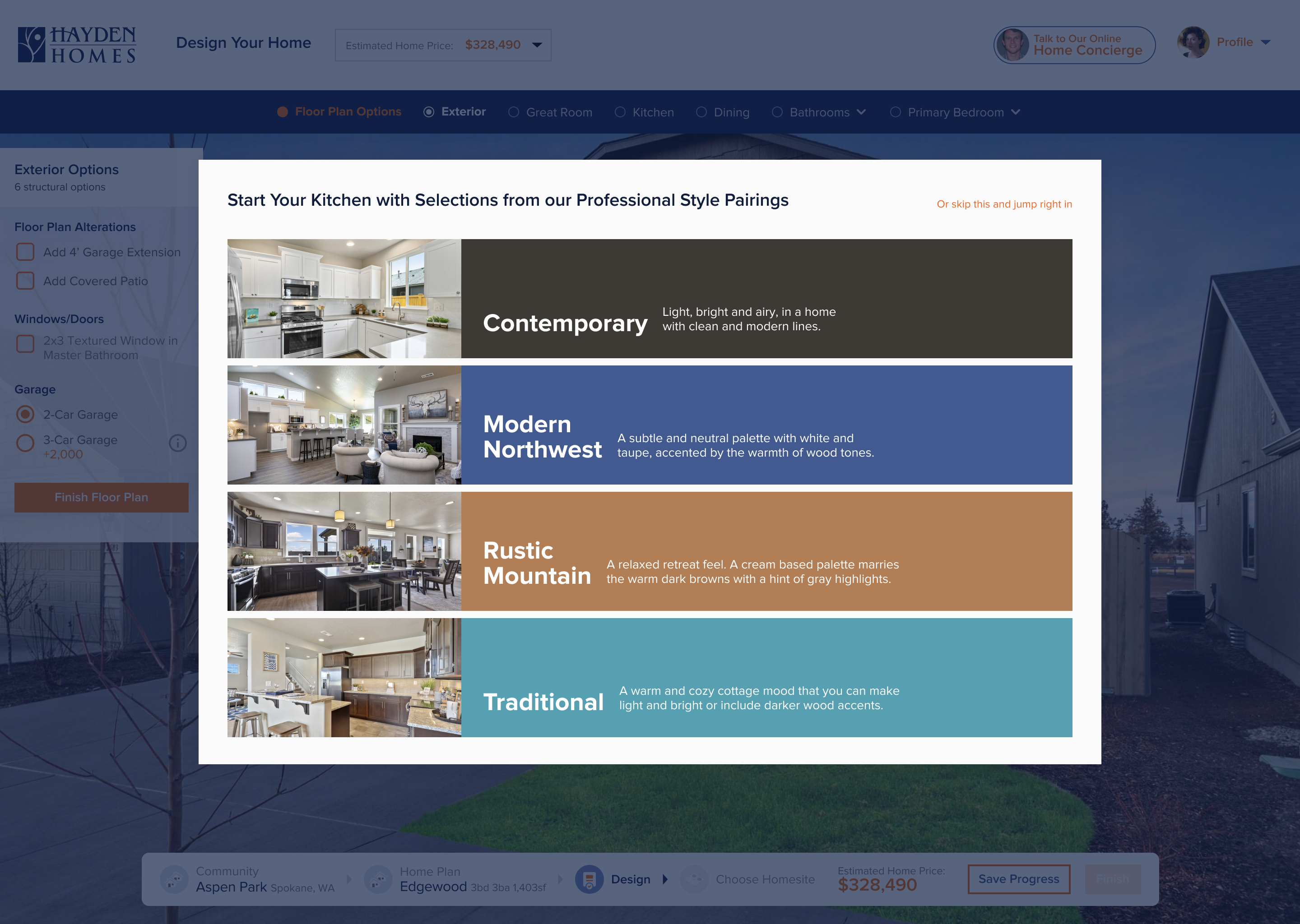
The prototype. A short wizard ("What kind of life would you like to live in your new home?") that recommends homes, a floor-plan and packages step, an options visualizer with live pricing built from Hayden's pre-rendered images, lot selection, and a summary where the buyer can reserve a lot for a deposit, save and create an account, or talk to a sales agent.
What the six testers told us. Five of six found value in the wizard questions, and one refused them because she did not want to be segmented. All six found the visualizer useful, and pricing was the part they valued most, though two did not notice the price changing. All six wanted more information on plans: 3D, photos, video, lot details. Five of six mentioned, unprompted, that they wanted to see past homebuyers' experiences. All six understood that the Buy Home button would reserve a lot for $250, and five of six were hesitant to do that online; several said they would visit the lot in person and then come back to reserve it. All six would create an account to save their visualizer choices, and all six wanted to compare floor plans side by side.
The decision that came out of it. Testers did not want the sales rep removed from the process; they wanted the online tool to get them further before that conversation. So Phase One narrowed to two things: a Design Your Home experience built on Hayden's pre-rendered home images, with no in-browser 3D, and a Reserve a Home Online flow that starts by interviewing buyers about what keeps them engaged after a reservation. The engagement moved from sprint rigor to an hourly, flexible model with testing added on when a question needed answering.
The archive holds the journey map, the Design Your Home UX, the visualizer UI prepared for development, and a Hayden Homes design system with colors, typography, icons and core components.
Outcome
Six of six testers rated the experience positively, using words like helpful, efficient and intuitive. The sprint reframed the goal from replacing the sales conversation to earning it.
Gallery
Design Your Home, floor plan step.
Design Your Home, kitchen options with live price.
Lot selection map, Aspen Park.
Visualizer on iPhone with estimated price.
Earnest money confirmation.
Community and homesite summary.